
PayID pokies withdrawals: how the cash-out side actually runs
A withdrawal rides the same NPP rail as a deposit but is not a mirror image of one. This page sets out the identity checks that gate a first cash-out, typical processing and bank-crediting times, what "pending" and reversal windows mean, limits, fees, and the handful of things that genuinely slow a payout.
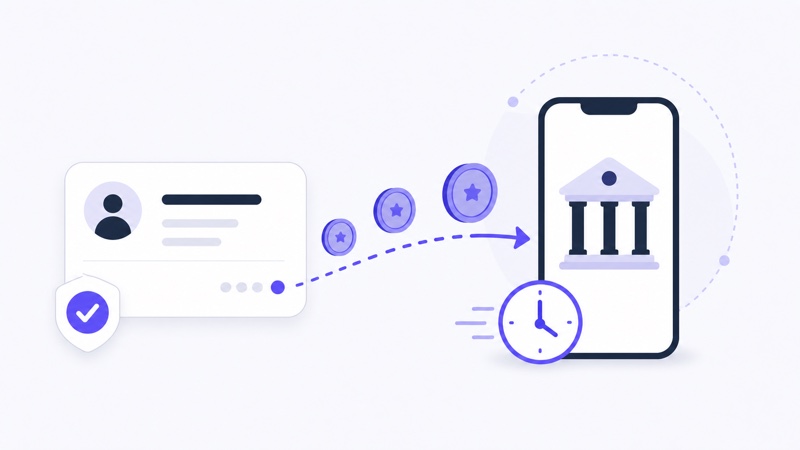
What a PayID withdrawal actually is
A PayID withdrawal is a transfer the site initiates, over the New Payments Platform (NPP), to a PayID you have nominated: your own registered mobile number, email address, or ABN. It is the reverse leg of a deposit, but the two are not symmetrical processes. A deposit only needs a valid identifier to exist on the receiving end; a withdrawal needs the site to first confirm that the identifier you are asking it to pay actually belongs to you, since it is now the one sending money out rather than simply accepting it in.
That asymmetry is the single most useful thing to understand before requesting a cash-out. The banking rail underneath a withdrawal is exactly as fast as the rail underneath a deposit; what differs is the approval step a site runs before it ever instructs a payment, which has no equivalent on the deposit side at all.
Why the site, not your bank, is the bottleneck
Once a site actually releases a withdrawal to the NPP, crediting to your account typically takes the same under-60-second window a deposit would. Delays that players experience with withdrawals almost always sit inside the site's own approval queue, before the payment is ever sent, not inside the banking system afterwards. Confusing these two stages is the most common source of "my withdrawal is taking forever" frustration, when in fact the banking leg has not even started yet.
02Identity verification before your first cash-out
Before releasing a first withdrawal, a site will typically run know-your-customer (KYC) checks: confirming your name, date of birth and address against a form of photo identification, and checking that the PayID nominated for the withdrawal resolves to an account in that same name. This is standard practice across payment methods generally, including card and bank-transfer sites, not something PayID introduces or makes stricter.
What documents are commonly requested
A driver licence or passport is the most frequently requested primary document, sometimes paired with a utility bill or bank statement to confirm an address. Some sites also ask for a short selfie-style photo holding the identification, as an extra check against a document being used by someone other than its owner. None of this is PayID-specific; it is the same identity-verification pattern used by any payment provider handling customer funds.
Why the name on the PayID has to match
Because the NPP's payee name-check surfaces the registered account name before any transfer completes, a site can cross-reference that name against the identity documents it already holds for you. A mismatch, where the PayID nominated resolves to a different name entirely, is the single most common reason a first withdrawal stalls, since a compliant operator will not send funds to an account it cannot confirm belongs to the account holder requesting the cash-out.
03Step-by-step: requesting a withdrawal
Once identity checks are complete, the mechanics of requesting a withdrawal are largely the same from one site to the next. Open the cashier or banking section of your account, select withdrawal, choose PayID as the method, and nominate the identifier, mobile number, email or ABN, that you want the funds sent to. Enter the amount, confirm, and the request enters the site's processing queue.
Confirming the receiving identifier
Some sites let you save a PayID against your account after the first successful withdrawal, so future cash-outs skip the identifier-entry step entirely. Others ask you to re-enter or reconfirm it on every request as an extra fraud control. Neither approach is wrong; it reflects each operator's own risk settings rather than any rule attached to PayID itself.
After submitting, most sites show a status of "pending" or "processing" in your account history. This status describes the site's internal review, not a banking-side delay, and is the stage covered in more detail in section 05.
04Typical processing times, deposit versus withdrawal
A deposit typically completes end to end, banking app to credited balance, in under two minutes. A first withdrawal is a different timeline entirely: the banking leg is just as fast once released, but the approval queue in front of it commonly runs from a few hours up to two business days, depending on how quickly a site's verification team can review the request and how many documents were still outstanding beforehand.
Why a second or third withdrawal is usually faster
Once an account is fully verified and has a track record of successful cash-outs, subsequent withdrawal requests generally clear the site's internal review much faster, often within the hour, because the identity and PayID-matching checks have already been satisfied and do not need repeating in full each time. Some sites do still apply a short standard review window to every request regardless of history, as a baseline fraud control.
| Stage | Deposit | Withdrawal (first) | Withdrawal (verified, repeat) |
|---|---|---|---|
| Identity check required | No | Yes | Rarely, unless flagged |
| Site-side queue | Seconds | Hours to 2 business days | Often under an hour |
| NPP bank-crediting time once released | Under 60 seconds | Under 60 seconds | Under 60 seconds |
| Typical end-to-end time | Under 2 minutes | A few hours to 2 business days | Under 1-2 hours |
Pending status and reversal windows explained
"Pending" on a withdrawal almost always describes the site's own review stage, not a banking clearing period. Once a site actually releases the payment into the NPP, there is generally no multi-day clearing window on the banking side; the receiving bank credits it within the usual near-instant timeframe. If a withdrawal has been marked "pending" for several days with no update, the delay is sitting inside the operator's process, and that is the point at which contacting its support team, with your account and request details ready, becomes the useful next step.
Reversals are the exception, not a routine event
A genuine reversal, where a released payment is pulled back after settlement, is uncommon and depends entirely on cooperation between the sending and receiving financial institutions; it is not an automatic feature of the NPP the way a card chargeback is of card networks. Some sites build in a short cancellation window, commonly a few minutes to a few hours, during which a player can cancel a withdrawal request themselves before it is released, distinct from a bank-side reversal after the fact. Read a site's own cashier terms to see whether such a window exists and how long it lasts, since this varies by operator and is not standardised.
06Withdrawal limits: what actually caps a payout
As with deposits, PayID itself sets no cap on a withdrawal amount. The practical ceiling comes from two places: the site's own per-transaction and per-day withdrawal maximums, which are commonly lower than deposit maximums and sometimes tiered by verification level, and, less often, a receiving-bank limit on incoming NPP payments, which is rarely the binding constraint since banks generally accept incoming transfers with far more headroom than they allow for outgoing ones.
Tiered limits by verification level
Several operators raise withdrawal caps once an account has completed full identity verification, sometimes offering a materially higher daily or weekly ceiling to verified players than to those who have only completed a first, partial check. This is a common structure across online payment providers generally and reflects standard fraud-prevention tiering rather than anything specific to PayID as a payment rail.
A large withdrawal that exceeds a site's single-transaction maximum is typically split into two or more payments processed on consecutive days rather than declined outright, though the exact handling differs by operator and should be checked in the site's own terms before assuming either outcome.
07Fees on withdrawals
Fee treatment on withdrawals is less consistent than on deposits. Some operators process PayID withdrawals free of charge as a matter of course; others apply a flat processing fee per withdrawal, commonly in the order of a few dollars; and a smaller number apply a percentage-based fee, which becomes more noticeable on a larger cash-out than on a small one. None of this is set or disclosed by PayID itself, since PayID has no fee schedule of its own; the receiving bank generally does not charge to receive a standard NPP payment either.
Where to check before requesting a large withdrawal
A site's banking or cashier terms page is the only reliable source for its specific withdrawal fee structure, and checking it before requesting a large amount is a better habit than reading it after a fee has already been deducted. A fee applied without prior disclosure anywhere in the site's terms is a reasonable basis for a complaint to the operator directly, though, as covered on our legal status page, there is no Australian regulator to escalate that complaint to if the operator does not resolve it.
08What slows a withdrawal down
Most withdrawal delays trace back to one of four causes, and identifying which one is in play is the fastest way to resolve a stuck request rather than simply waiting indefinitely.
The four most common causes
Outstanding identity documents are the leading cause on a first withdrawal; a request often sits untouched in a queue until every required document has been received and reviewed. A name mismatch between the nominated PayID and the account holder's verified identity is the second, and typically requires nominating a different, matching identifier before the request can proceed. An unusually large withdrawal relative to a player's deposit history can trigger a manual anti-fraud review even on a fully verified account. And reduced staffing on weekends or public holidays can extend a site's own review queue, even though the NPP rail underneath keeps running around the clock regardless of the day.
A worked example: a $380 first withdrawal
A player requests a $380 withdrawal for the first time on a Tuesday afternoon, nominating a PayID linked to an account in their own name. Because it is their first cash-out, the site places the request into identity review: it checks the submitted driver licence against the account details and confirms the nominated PayID resolves to a matching name. That review takes just under a day in this example, clearing early Wednesday morning, at which point the site releases the payment into the NPP. The receiving bank credits the $380 within roughly 40 seconds of release, meaning the total elapsed time from request to funds in the account is a little under 18 hours, almost all of it spent in the site's own verification queue rather than in transit.
Two weeks later, the same player requests a second withdrawal of $210. Because the account is now fully verified and the previous cash-out completed without issue, the site's review takes roughly 25 minutes rather than most of a day, and the bank-crediting step is again under a minute once released. The banking leg has not changed at all between the two requests; only the site-side queue has shortened, which is the pattern to expect once an account has a clean withdrawal history.
Our view: the gap between a first and a repeat withdrawal is the most informative single data point a player can look at, since it isolates exactly how much of the delay was ever the bank's doing.
10Where withdrawals fit next
Withdrawal speed and verification requirements say nothing about whether a site is licensed to operate in Australia at all; our are-payid-pokies-legal page sets out the Interactive Gambling Act, ACMA's enforcement record, and exactly what having no Australian licence means if a withdrawal is ever refused outright. If you have not yet made a deposit, our payid-deposits page covers registration, step-by-step deposit mechanics and typical deposit timing, which is a considerably simpler process than the one described here. Anyone weighing PayID against other options on the way in or out may also find our payid-vs-alternatives comparison useful. And because a stalled withdrawal can sometimes be a prompt to reassess pace of play rather than only a payments question, our safe-and-responsible-play page covers self-set limits and where to get free support.
Key takeaways
- A withdrawal is not the reverse of a deposit: it requires the site to verify your identity and PayID before releasing funds.
- Once released, a PayID withdrawal credits your bank account in under 60 seconds, the same as a deposit.
- First-withdrawal review commonly takes hours to two business days; verified, repeat withdrawals are usually much faster.
- "Pending" almost always describes the site's own queue, not a banking clearing period.
- Outstanding documents, a name mismatch, an unusually large amount, or weekend staffing are the four most common causes of delay.
How we researched this
Figures on this page are drawn from Australian Payments Plus and NPP Australia's published material on PayID and Osko settlement timing, publicly available identity-verification and anti-money-laundering guidance applicable to Australian payment providers, and standard NPP transfer-timing figures banks quote for real-time payments. Figures were checked in July 2026; where a specific operator practice could not be independently confirmed across the industry, it has been described as common rather than universal.
Frequently asked questions
What happens if the PayID I withdraw to doesn't match my account name?
A site's verification step exists precisely to catch this before funds move. If the receiving PayID belongs to someone else, most operators will hold the withdrawal and ask you to nominate a PayID that matches the name on your player account, rather than sending funds to a mismatched identifier. Sending winnings to a third party's account is not something a compliant operator will do on request.
Can a site ask for identity documents again on a second or third withdrawal?
Yes, though it is less common once an account is fully verified. A site may re-request documents if your withdrawal amount jumps well above your usual pattern, if your account details changed, or if its own risk system flags the request for another look. This is standard practice across regulated and unregulated payment flows alike, not something unique to PayID.
Does a public holiday delay a PayID withdrawal?
The NPP settlement rail itself runs 24 hours a day, 365 days a year, including public holidays, so a bank-side transfer is not affected. Any delay on a holiday is more likely to come from a site's own verification team having reduced staffing that day, which affects how quickly an approval is processed, not how quickly the money moves once it is released.
What if a withdrawal is approved but never arrives in my bank account?
Ask the site for the exact time it released the payment and any transaction or reference number, then check that reference against your own bank statement and banking app notifications. If the site's records show a release and your bank shows nothing received after several hours, the next step is raising it directly with your bank, since a payment that left an NPP participant but never posted is a banking-side tracing issue rather than a site-side one.
Can I withdraw a different amount than I originally deposited?
Yes. A withdrawal request is not tied to matching a prior deposit figure; you can withdraw any balance available in your account, subject to the site's minimum and maximum withdrawal rules. Some operators do apply extra scrutiny when a withdrawal is many times larger than a player's typical deposit history, which is a routine anti-fraud check rather than a restriction on the amount itself.
Is there a minimum amount I can withdraw through PayID?
PayID itself has no minimum transfer value; a bank will process a small transfer the same way it processes a large one. Any minimum withdrawal threshold comes from the site, and commonly sits somewhere in the $20 to $50 range, though this varies by operator and is usually disclosed in the site's own banking or terms page.